
Long Beach Home Selling Timeline: Listing to Close
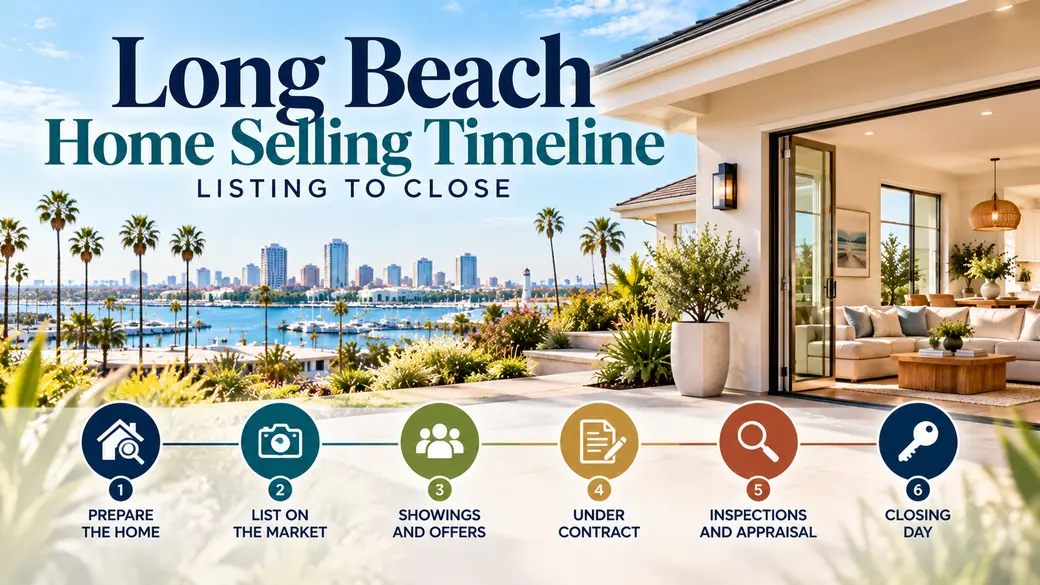
A Long Beach home selling timeline includes the work you complete before listing, the time your property spends on the market, the steps that follow an accepted offer, and the final transfer of ownership. Each stage depends on your home's condition, the asking price, buyer financing, contract deadlines, and escrow requirements. This guide explains the sequence so Long Beach homeowners can plan a move, organize paperwork, and avoid confusing a suggested schedule with a guaranteed closing date.
How Long Does It Take to Sell a Home in Long Beach?
There is no single timeline that applies to every Long Beach sale. As an illustration, a seller might spend one to three weeks preparing a property, several weeks marketing it, and approximately three to five weeks in escrow after accepting an offer. That can produce an overall schedule of roughly six to twelve weeks, but it is a planning example rather than a verified citywide average. Some homes sell sooner; others require substantially more time.
To set realistic expectations, compare recently sold and currently listed homes that match your neighborhood, property type, price range, and condition. A condominium with association documentation may have different requirements from a detached home. A probate or trust-related transaction may require additional authority and title review.
For broader context, the California Association of REALTORS reported that the statewide median time to sell an existing single-family home was 26 days in July 2026, and the statewide sale-price-to-list-price ratio was 99.3%. These are California-wide figures, not Long Beach measures, and do not predict how long any individual listing will take. See the July 2026 statewide housing report.
Long Beach Market Context for Sellers in 2026
A July 2026 local data snapshot, referenced in Marie Goodloe's existing guide to preparing a Long Beach sale, reported a June 2026 median sale price of $935,000 across 245 recorded transactions in the Long Beach postal-city area. This is historical market context, not a current listing valuation or a statistic limited to city boundaries.
A verified Long Beach-specific median days on market, current inventory count, and sale-to-list-price ratio were not available from the source material reviewed for this article. Rather than filling those gaps with regional averages, ask for a fresh set of comparable sales and active listings before establishing your home's likely marketing period.
Stage 1: Prepare the Property Before Listing
Pre-listing work can be simple or extensive. A home that is already in good condition may need decluttering, cleaning, photography, and document organization. A property with deferred maintenance, incomplete renovation records, or a complicated ownership structure may need more lead time.
Begin with a comparative market analysis that looks at similar nearby properties, their conditions, and recent sales. Next, decide which improvements are necessary for safety, access, disclosure accuracy, or a clear presentation. Expensive renovations are not automatically the best choice. A focused plan can be more helpful than improving every room without considering buyer expectations.
If you are deciding what to fix, review the article on which pre-listing repairs deserve attention. If that article has not yet been published, activate this link when its page is live.
Pre-listing checklist
- Review recent comparable sales and active competition.
- Confirm ownership, signing authority, loan payoff details, and any existing liens.
- Identify material property issues and evaluate needed repairs.
- Gather permits, warranties, available inspection reports, and records of improvements.
- Declutter, clean, and organize the home's rooms and exterior areas.
- Prepare a realistic showing schedule and plan for pets and valuables.
- Arrange photography after the property is ready for buyers to see.
- Discuss applicable California disclosures and any transaction-specific exceptions with the appropriate professionals.
Once repairs and cleaning are planned, focus on how each room will appear in photographs and showings. These room-by-room ideas for a more inviting presentation explain how lighting, furniture placement, and uncluttered spaces can help buyers understand the home.
Stage 2: Launch the Listing and Evaluate Buyer Interest
Once preparation is complete, the listing can be published with accurate property details, photographs, showing instructions, and a price supported by relevant comparisons. The first response from buyers may help identify whether presentation, access, or pricing needs attention.
Keep the home reasonably available for appointments, while using a showing plan that works for your household. If interest is slower than expected, review competing homes and specific buyer feedback before changing the strategy. An absence of offers does not by itself prove that only the price is wrong.
When an offer arrives, compare more than its headline price. Important details include the buyer's financing, proof of funds where relevant, requested credits, deposit terms, property-related contingencies, proposed closing date, and any special possession arrangements. An offer that is easier to perform may be more practical than a higher offer with unresolved conditions.
Home Selling Timeline at a Glance
The following durations are illustrative planning ranges, not verified Long Beach market averages. Several escrow activities overlap, so their durations should not be added together.
| Stage | Planning guidance | Main tasks |
|---|---|---|
| Preparing to list | Approximately one to three weeks for a straightforward property; longer when needed | Pricing research, documents, maintenance decisions, staging, photographs |
| Active listing | Variable, from days to many weeks or longer | Showings, feedback, marketing adjustments, offers |
| Offer review | Based on offer terms and response deadlines | Compare price, financing, contingencies, and timing |
| Escrow after acceptance | Often planned around three to five weeks for a financed sale, but negotiated | Disclosures, inspections, appraisal, lender and title review |
| Closing and possession | Determined by the contract, funding, recording, and possession terms | Final review, signing, funding, recording, handover |
Stage 3: Open Escrow and Complete Required Reviews
After the parties sign an agreement, escrow coordinates deposits, documents, instructions, and closing conditions. The purchase agreement establishes the applicable dates for investigations, contingencies, and performance. There is no universal Long Beach inspection deadline that overrides a signed contract.
Buyers may schedule property inspections, review disclosures, and request clarification about issues that affect the home's condition or intended use. Repair requests and credits are negotiable under the contract. Sellers should document agreements and respond promptly so both sides know which work or adjustments are expected before closing.
California residential sellers commonly have disclosure duties, including information about known property conditions. Particular transfers may qualify for statutory exemptions, but an exemption from one form does not necessarily eliminate every other disclosure duty. The California Department of Real Estate disclosure guidance provides a starting point. Estate representatives, trustees, and anyone facing an ownership or title question should obtain advice specific to the transaction.
Stage 4: Appraisal, Financing, and Title Work
For a financed offer, the buyer's lender reviews income and asset documentation, credit, the property, and applicable loan requirements. The lender may order an appraisal, and the escrow team or title professionals may identify issues that must be resolved before recording.
If an appraisal comes in below the contract price, the parties may need to revisit financing, buyer cash, or transaction terms. If a title report identifies an unresolved lien or ownership question, the seller may need to supply additional records. These situations can affect timing, but not every issue results in a canceled sale.
For many covered mortgage transactions, federal rules require the buyer to receive a Closing Disclosure at least three business days before consummation. Exceptions apply to certain products. The Consumer Financial Protection Bureau's closing document guidance explains the requirement. Sellers should confirm the actual signing, funding, and recording schedule with escrow rather than assume that signing alone transfers ownership.
Stage 5: Final Walk-Through, Recording, and Moving Out
Before closing, the buyer may conduct a final walk-through to check the property's agreed condition and confirm completion of any negotiated work. Keep utilities active as required, protect the home from new damage, and leave items included in the sale in place.
Escrow and title coordinate final documents and funds. Ownership transfer is generally completed through the applicable recording process. Possession and key delivery follow the written agreement, which may provide for a different handover time. Sellers should confirm when they must leave, where keys and access devices will go, and whether any post-closing occupancy arrangement applies.
What Can Delay a Long Beach Home Sale?
Delays often arise when a necessary task is discovered too late. Common examples include incomplete seller records, buyer financing changes, inspection concerns, appraisal differences, title issues, insurance availability, and slow decisions about repairs or credits. A sale involving probate, trusts, multiple owners, or tenants may require additional coordination.
The practical response is to identify decision makers and deadlines early. Keep important records together, ask for written updates when a problem affects the schedule, and confirm changes through the appropriate contractual process. Avoid planning movers, replacement housing, or large expenditures around an assumed closing date that the parties have not agreed upon.
Understanding Seller Closing Costs and Net Proceeds
Net proceeds are the amount the seller receives after subtracting loan payoffs, agreed compensation, closing charges, negotiated concessions, and other applicable obligations from the sale price. A preliminary seller net sheet is useful before listing and should be revised when offer terms change.
Potential charges include negotiated broker compensation, escrow and title services, recording charges, property-tax adjustments, transfer taxes, loan payoff charges, and association documents or fees when applicable. Which party pays a particular cost may depend on the contract, local practice, and specific transaction.
The Los Angeles County Recorder lists documentary transfer tax at $0.55 per $500, or fractional part, of taxable consideration when the tax applies. This is equivalent to $1.10 per $1,000 before rounding and other calculation considerations. Long Beach is not among the cities listed by the county with an additional special city rate. Check the county's transfer tax instructions and have escrow calculate the actual amount, including any applicable exemptions or amounts excluded under the rules.
| Possible seller expense | How to estimate it |
|---|---|
| Broker compensation | Use the amount negotiated in signed agreements; there is no universal fixed rate. |
| Escrow and title charges | Request a property-specific estimate and confirm the agreed allocation. |
| Documentary transfer tax | Apply the county's published rules to taxable consideration; ask escrow to verify. |
| Property taxes and assessments | Review the current tax bill and closing-date adjustments. |
| HOA or condominium charges | Ask the association for current document, transfer, and account information. |
| Payoffs, repairs, and buyer credits | Use lender payoff statements and the executed transaction terms. |
As an illustration only, a fully taxable $935,000 transfer would produce $1,028.50 in county documentary transfer tax using $0.55 for each $500 increment. This is a mathematical example, not a quote of closing costs for any particular property.
Planning a Sale When You Are Downsizing or Managing an Estate
Some Long Beach sellers must coordinate more than a move. Downsizing may involve sorting belongings and choosing a replacement home. A trust or probate-related sale may require determining who is authorized to sign and whether court procedures or special contract terms apply.
Start these conversations before setting a listing date. Confirm authority, relevant documents, access to the property, and the practical move-out plan. This helps avoid a situation in which the marketing schedule moves faster than the legal or personal decisions needed to complete the sale.
Start Your Long Beach Sale With a Clear Timeline
A useful home selling plan starts with your own property, not a generic market average. If you are considering a Long Beach sale, Marie Goodloe of Y Realty can help you review preparation priorities, comparable listings, expected transaction steps, and the questions to bring to escrow or other professionals. You can also request a property-specific valuation conversation before deciding when to list.
Call or text (310) 251-0795 to discuss your goals and a realistic plan for moving from listing preparation to closing, without pressure to rush the decision.
Frequently Asked Questions
How many weeks does it take to sell a home in Long Beach?
There is no verified local average that covers preparation, marketing, and escrow together. Six to twelve weeks can be a useful sample plan for a straightforward sale, but actual timing depends on the property, buyer demand, financing, and agreed contract dates.
How long does escrow take after a seller accepts an offer?
A financed transaction may be planned around three to five weeks, but the closing date is negotiated and recorded in the agreement. Inspections, lender requirements, title work, and other conditions may change the schedule.
Should I make repairs before putting my Long Beach home on the market?
Review safety concerns, known defects, and visible maintenance needs before spending on cosmetic updates. Your home, likely buyer expectations, disclosure duties, and estimated repair costs should guide what to complete before listing.
What seller expenses should I budget for?
Common categories include negotiated broker compensation, escrow and title charges, transfer taxes, tax adjustments, loan payoffs, association fees when applicable, and any agreed buyer credits. Ask for a net-proceeds estimate based on your own transaction.
Can a trust or probate sale take longer?
Yes. A transaction may need confirmation of signing authority, title, legal procedures, or court requirements. The impact depends on the ownership circumstances, so consult an appropriate California professional before committing to a closing schedule.
Categories
Recent Posts









GET MORE INFORMATION